Cancer-Detection-Model
AI ML EngineerImpact
- Built two CNN architectures (Baseline: 4M params vs Advanced: 1.5M params) achieving superior efficiency via Global Average Pooling
- Designed GPU-optimized training pipeline with mixed-precision AMP, async CUDA streaming prefetcher, and RAM image caching
- Achieved 92% validation accuracy with confidence-tier reliability analysis across 220K histopathology images
- Implemented comprehensive model evaluation generating 14 visualizations including ROC curves, confusion matrices, and precision-recall analysis
Skills
Project Abstract & Details
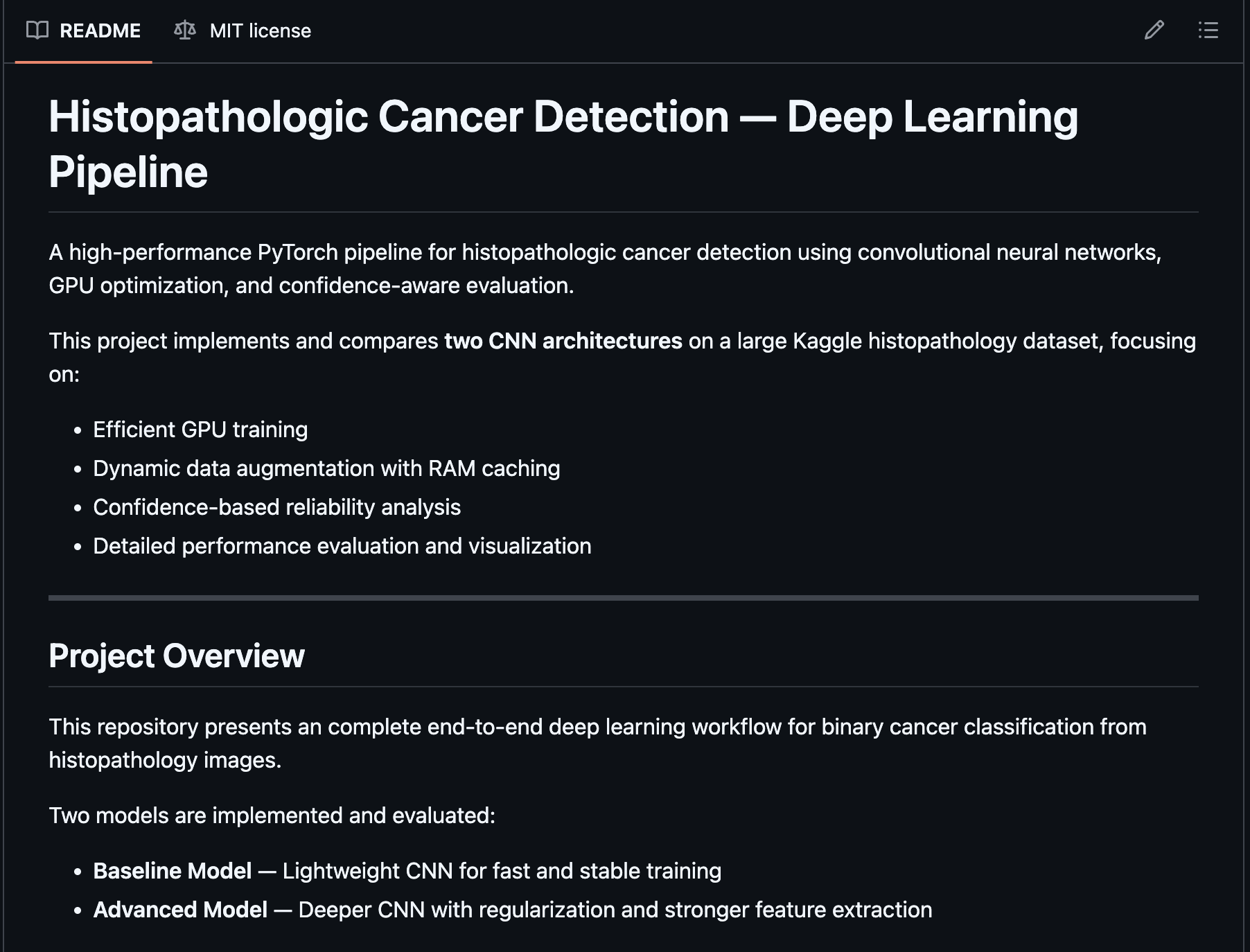
A machine learning–based cancer detection model designed to analyze histopathology images to identify patterns indicative of malignant disease. The project compares two CNN architectures: a Baseline model (~4M parameters) with three dense layers and a smaller Advanced model (~1.5M parameters) using Global Average Pooling and dropout regularization. Despite having 2.6x fewer parameters, the Advanced model achieves higher validation accuracy (92% vs 83%) while being more memory-efficient and less prone to overfitting. The model leverages supervised learning to distinguish between cancerous and non-cancerous cases, enabling early detection, risk stratification, and decision support for clinicians.
Key Features
CNN Architecture Comparison
Baseline (4M params, 3 dense layers) vs Advanced (1.5M params, GAP + dropout) — Advanced achieves 92% accuracy with 2.6x fewer parameters
Data Augmentation Pipeline
Rotation, flipping, zoom, and brightness adjustments via torchvision transforms to combat overfitting and improve generalization
GradCAM Visualization
Gradient-weighted Class Activation Mapping for interpretable heatmaps showing which regions the model focuses on for diagnosis
GPU-Optimized Training
Mixed-precision AMP, async CUDA streaming prefetcher with pinned memory, and RAM image caching for maximum throughput
Imbalanced Data Handling
Weighted loss function with class-balancing strategies for multi-class histopathology classification across tissue types
220K Image Pipeline
End-to-end pipeline from raw histopathology slides to confidence-tiered predictions with comprehensive evaluation metrics
Architecture
Two CNN architectures were built and compared. The Baseline model uses 3 convolutional blocks (32→64→128 filters) followed by three dense layers (256→128→4). The Advanced model uses 4 convolutional blocks (32→64→128→256) with Global Average Pooling replacing dense layers, plus dropout (0.5) and batch normalization for regularization. Training uses cross-entropy loss with Adam optimizer (lr=0.001, ReduceLROnPlateau). A custom data loader pipeline with async CUDA prefetching maximizes GPU utilization on histopathology patches.
Architecture diagram placeholder